2026-09-16
Male Under-Eye Fat Repositioning: Dark Circle Types & Correction Guide
Discover the 5 main dark circle types and why male under-eye fat repositioning uses transconjunctival laser techniques to smooth hollows and bulges without scarring.

Essential Guide to Dark Circle Types and Correction Before Male Under-Eye Fat Repositioning
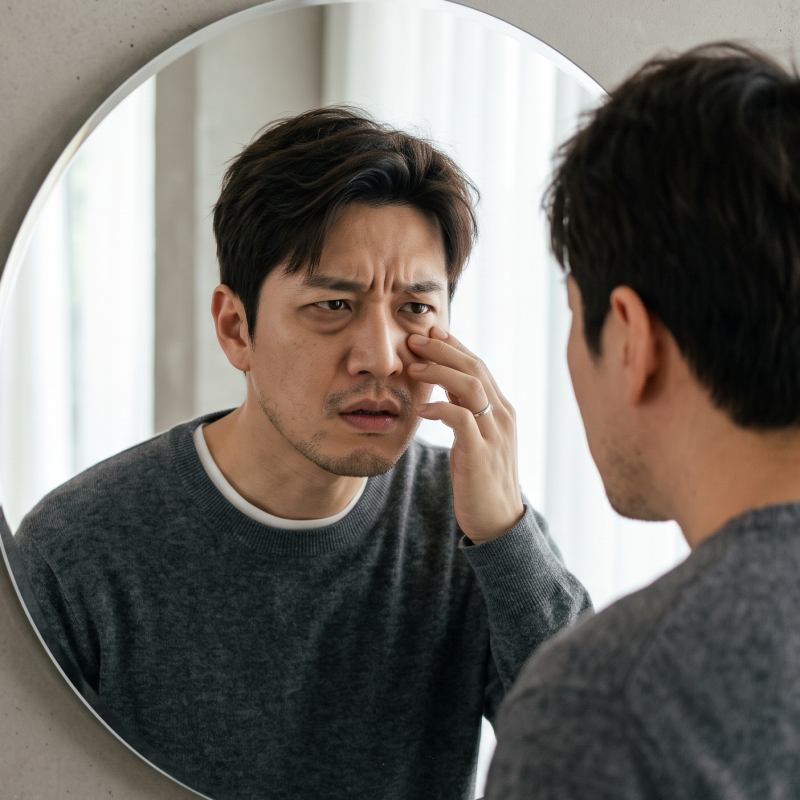
Many men in their 30s to 50s who lead active professional lives often hear comments from others even when they feel great and had a good night's sleep:
"Are you feeling sick today? You look really pale."
"Have you been working late recently? You look especially tired."
When these remarks become frequent, it is natural to look in the mirror, check under the eyes, and research male under-eye fat repositioning to clear away those dull, heavy shadows.
However, the underlying causes of dark under-eyes vary significantly from person to person. Choosing surgery blindly based on a misdiagnosis makes it difficult to achieve the desired rejuvenation. Therefore, it is critical to accurately determine your specific under-eye type first.
5 Types of Dark Circles & Self-Check Guide
Under-eye shadows (dark circles) do not stem from a single cause. Depending on skin thickness, pigmentation, blood vessels, orbital bone structure, and fat distribution, they can be categorized into 5 main types and mixed forms.
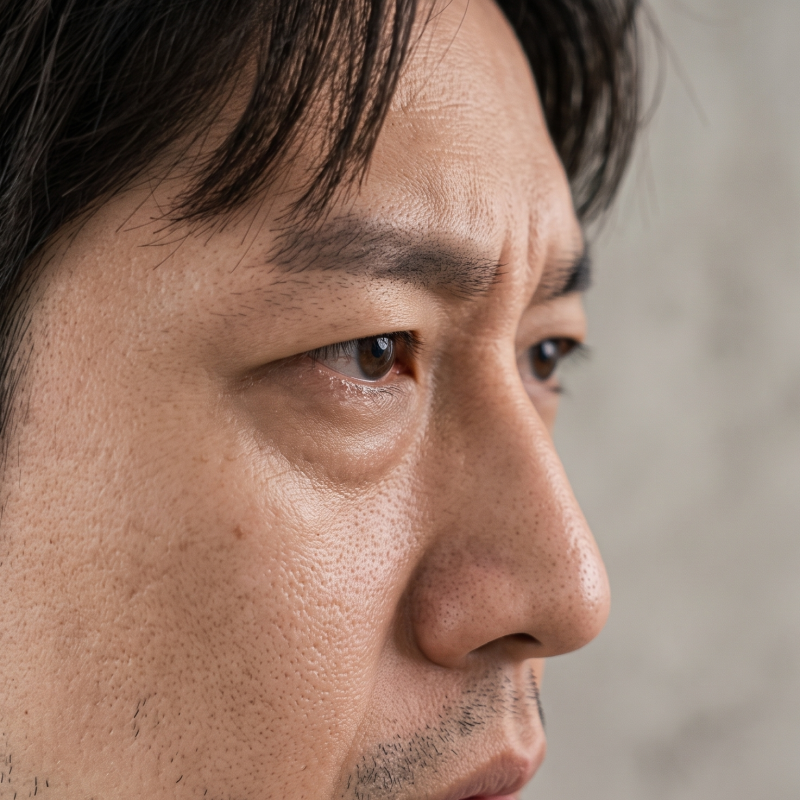
1. Protrusion Type (Bulging Fat)
This is the most common presentation among men considering under-eye fat repositioning. The orbital fat supporting the eyeball bulges outward due to gravity and weakened supporting structures. When light falls from the front or above, a distinct crescent-shaped shadow forms beneath the protruding fat.
2. Depression Type (Hollow Tear Trough)
Contrary to protrusion, this type occurs when the 'tear trough ligament' between the under-eye bone and facial tissue is deeply grooved, or when the front cheek volume is depleted. Even without protruding fat, dark shadows appear because light cannot reach this valley-like depression.
3. Vascular Type (Visible Microvessels)
The skin around the eyes is among the thinnest on the human body. When the underlying orbicularis oculi muscle and microvenous plexus show through the thin dermis, they cast a reddish or deep bluish-purple hue. It characteristically darkens temporarily when fatigue or poor circulation causes the vessels to dilate.
4. Pigmented Type (Melanin Deposition)
This type involves actual melanin deposition within the skin tissue itself, creating a dark or brownish tone. Key triggers include UV exposure, chronic eye-rubbing habits, and post-inflammatory hyperpigmentation from atopic dermatitis or allergic rhinitis.
5. Atrophic Type (Thin Skin & Fine Wrinkles)
As collagen and elastic fibers deplete due to aging or genetics, the delicate under-eye skin turns crepey and paper-thin with dense fine wrinkles. The creased, folded skin produces an irregular surface that casts a dull, shadowed appearance.
6. Mixed Type (Complex Factors)
In reality, the vast majority of male patients do not present with just one isolated issue. Most exhibit a combination of 'Protrusion + Depression', where bulges and hollow troughs coexist, often accompanied by vascular or pigmented components.
Structural Changes When Protrusion Meets Depression
The core cause of a tired, aged expression in many men is the combined effect of 'protrusion' and 'depression'.
As the orbital fat pushes forward to form a mound and the tear trough directly beneath it hollows out, a sharp slope (step-off) is created. This stark difference in height casts a pronounced shadow under lighting—much like the deep shade beneath a mountain ridge.
Because this is a physical, anatomical shift rather than a simple lifestyle issue like fatigue or sleep deprivation, getting plenty of rest or applying brightening cosmetics will not make the shadow disappear.
Men, in particular, tend to have more defined skeletal contours and thicker skin than women, which causes the step-off to appear sharper, more angular, and more prominent when internal fat herniates.
Male Under-Eye Fat Repositioning Correction
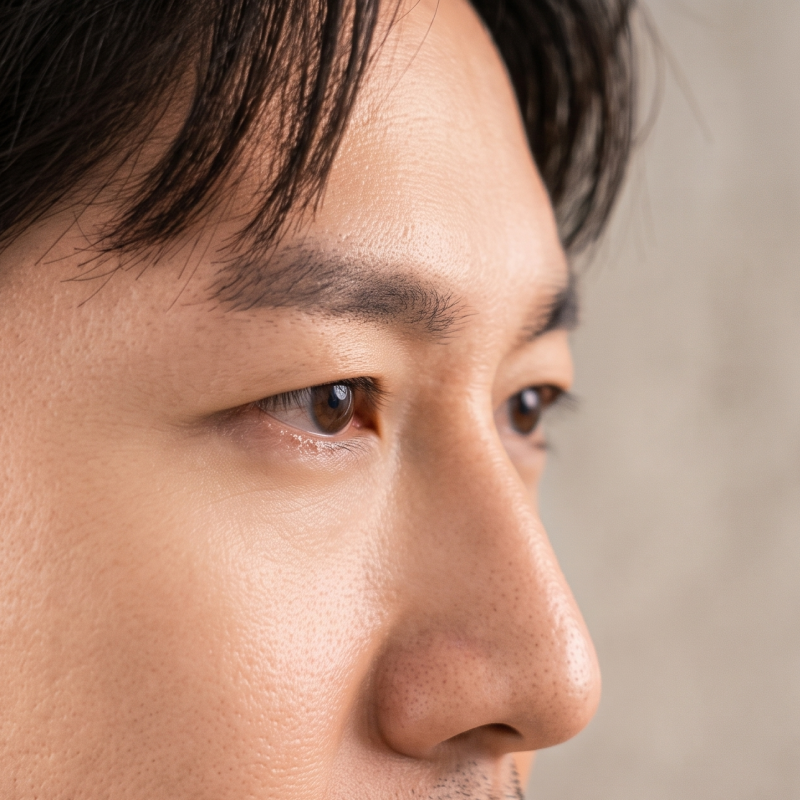
The key solution to address these complex structural issues is male under-eye fat repositioning. The most vital concept here is that it is a 'repositioning' to balance heights, not a 'simple excision' where fat is just cut out and discarded.
Excessively excising the protruding fat might make the area look flat initially, but over time, the under-eye area can become sunken and hollow, resulting in an even older, more fatigued look.
Therefore, the protruding orbital fat mound is dissected and evenly spread and shifted into the hollow, depleted tear trough below. By lowering what protrudes and filling what is sunken, the surgery aims to smooth the contoured under-eye area into a gentle, flat plane.
Utilizing Laser Encore Under-Eye Fat Repositioning

Surgical approaches are divided into external skin incisions and transconjunctival approaches through the inner mucous membrane.
Among these, the transconjunctival method—which leaves no external scar on the skin—is widely favored. Because the procedure is performed via the red conjunctiva inside the lower eyelid, concerns regarding visible sutures or external scarring are significantly minimized.
Our clinic utilizes a precision CO2 laser (such as the UltraPulse Encore Laser) during this transconjunctival approach.
Encore under-eye fat repositioning uses a micro-beam to incise the conjunctiva and precisely dissect and divide fat compartments. Utilizing the laser helps reduce unnecessary bleeding and swelling while assisting in delicate fat relocation. For these reasons, it is considered an ideal option for working professionals who cannot afford lengthy recovery downtimes.
Key to Refined Results: Surgical Expertise and Anatomical Precision
The under-eye area is a demanding anatomical zone where the skin is only about 0.5 mm thick, with the orbital septum, orbicularis oculi muscle, microvessels, and nerves intricately intertwined. Even for the same procedure labeled 'male under-eye fat repositioning', significant differences in naturalness and longevity can arise depending on the surgeon's technical precision and anatomical expertise.
Limitations by Type & The Need for Combination Approaches
While male under-eye fat repositioning is highly effective for smoothing shadows caused by 'protrusion' and 'depression', it is not an all-in-one remedy for every type of dark circle.
Pigmented Dark Circles: Melanin deposited within the skin itself cannot be eliminated by fat repositioning; it requires concurrent pigment laser treatments, such as laser toning.
Vascular & Atrophic Types: When the skin is excessively thin, revealing underlying vessels or losing elasticity, skin boosters, collagen stimulators, or radiofrequency (RF) lifting can be combined to reinforce dermal thickness and firmness.
Therefore, the crucial first step toward satisfactory results is receiving an accurate differential diagnosis from a board-certified plastic surgeon to determine whether your concern is purely fat herniation or a complex mixed type accompanied by pigmentation, vascularity, or skin laxity.
Post-Operative Recovery and Precautions
To ensure a smooth, stable recovery after surgery, it is essential to understand typical post-operative progress and precautions.
* During the first few days, bruising, swelling, minor oozing, chemosis (conjunctival swelling), foreign body sensation, or tightness in the eyes may occur depending on individual physiology.
* Swelling and bruising generally subside gradually over 1 to 2 weeks, while full stabilization of internal tissues and final contouring can take several months.
* In the early recovery phase, avoid activities that elevate intraocular pressure or blood pressure, such as heavy lifting, strenuous exercise, visiting saunas, or bending your head down.
* Alcohol and smoking impair blood circulation and can trigger inflammatory reactions, so they must be strictly avoided for a specified period.
Under-eye aesthetics can dramatically change facial expression based on millimeter-level structural variations. Rather than relying on exaggerated claims or superficial reviews, consult with a board-certified plastic surgeon with deep anatomical knowledge and extensive surgical experience.










Frequently Asked Questions
Will there be visible scarring after male under-eye fat repositioning?
No, there are no visible external scars. The procedure accesses the fat through the inner conjunctiva of the lower eyelid, eliminating external incisions and skin stitches, so you do not need to worry about visible scarring.
What problems can occur if under-eye fat is simply removed rather than repositioned?
The under-eye area can become hollow and sunken, making you look even more exhausted. Blindly cutting away bulging fat often leads to a hollowed tear trough over time; instead, repositioning is needed to spread the fat evenly into depressed zones.
Can under-eye fat repositioning resolve all types of dark circles?
No, it cannot resolve all types on its own. Fat repositioning effectively eliminates structural shadows caused by fat herniation and hollow grooves, but epidermal melanin pigmentation or visible microvessels require combination treatments like toning lasers or skin boosters.
How long is the recovery period and return to daily life after male under-eye fat repositioning?
Bruising and swelling generally resolve over 1 to 2 weeks. Using a transconjunctival laser approach minimizes bleeding and swelling for a faster return to daily activities, though full tissue stabilization may take several months.
What precautions should be taken during the post-operative recovery period?
Strictly avoid any activity that increases intraocular or blood pressure. Refrain from heavy lifting, high-intensity workouts, bending your head downward, and sauna use. Alcohol and smoking must also be avoided for a designated period to prevent poor circulation and inflammatory complications.